
For Elsa Sif Sandholt, the Icelandic concept of ‘radical trust’ helped forge a Firebird
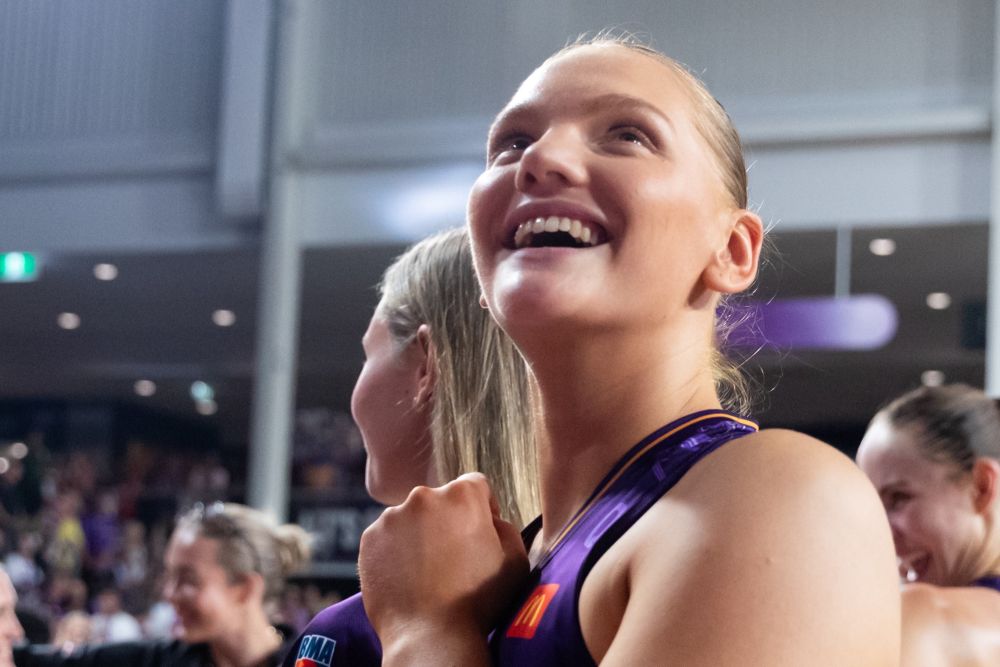
Elsa started playing netball when she was 14, but her rise has been meteoric. (Image: Supplied Firebirds/Mackenzie Sweetnam)
Long before she was a 192cm-tall Goal Shooter for the Queensland Firebirds, Elsa Sif Sandholt was a toddler in Reykjavik, perhaps destined to take over her grandparents’ bakery.
But in 2007, Elsa’s parents traded the midnight sun, the Northern Lights and frigid tundra of Iceland, for the beaches of the Gold Coast and the rainforests of its sub-tropical hinterland.
On the surface, it was as if they had moved to another planet.
But Elsa says Iceland and Australia are more similar than they may appear.
“[Australia and Iceland] are two very isolated places with climates that test their inhabitants, at very different ends of the spectrum,” she says.
And the two countries share an approach to life that she says has been a guiding light for her, as a “bit of a stress-head”.
“In Iceland it’s called the Þetta reddast mentality, which has always been very significant to me,” she says. “Þetta reddast reminds you to take a breath, what will happen will happen, let it go, look positively to the future.
“I think it’s a commonality between Australian and Icelandic culture, where things are rarely a problem... It’s pretty similar to the [‘She’ll be right mate’ attitude] actually.”
Radical trust’ and figuring it out
Elsa was three years old when she moved to Australia, which may have made the transition easier compared to her two older sisters, who were teenagers at the time.
She had an aunt already living in Australia, and her parents were keen to expand their horizons.
“[Iceland is] definitely a cold, dark place, so hearing the stories from my Aunty about the sun and the beach… it’s a bit of a dream come true for [my parents] to be able to give that opportunity for themselves and their kids,” she says.
Elsa was raised speaking Icelandic in the home, and Icelandic music, food and culture featured strongly in her upbringing.
Her grandparents have a third-generation bakery in Reykjavik, her dad is a keen cook, and for her, food was a key means of connection to Icelandic culture.
“Hangikjöt, it’s a specifically cured type of meat, it was the best day ever when my dad found a butcher in Australia that made it.”
Elsa says her parents also raised her in the Icelandic way, with a philosophy of what she calls “radical trust”.
It’s a typically Nordic approach that encourages self-sufficiency from a young age.
“It’s a unique blend of independence and responsibility,” she says. “You just have to figure it out, which I think has served me well to this point.”
‘I can be my own person’
She attributes some of her sporting success to that self-reliance, and to having strong women role models in her life.
In 1975, Iceland’s women went on strike, in a day of action called the Kvennafridagurinn. Around 90 per cent of women across the country boycotted work, domestic chores and parenting, to protest unfair work and pay conditions.
At the time, it’s reported that Icelandic women averaged less than 60 per cent of the income of their male counterparts.
In 1976, Iceland’s parliament enshrined the right to equal pay in law. And four years later, Iceland voted in the world’s first democratically elected president in Vigdís Finnbogadóttir.
“[Iceland has] one of the most ‘female-strong’ cultures,” Elsa says. “My Grandmas were part of the big Icelandic strike on the 24th of October 1975, where women walked out of work and their homes for gender equality. That affected my Mum and the women in my family very significantly.”
“I grew up with those strong female figures around me, especially my sisters as well, they really showed me I can be my own person. I think that was key for me growing up.”
She was raised competing in rhythmic gymnastics, and didn’t take up netball until she was 14.
Just a few years later, she qualified for the under-21 Australian netball team, and today is being described as one of the brightest goal-scoring prospects in Australian netball.
“To get to where I’ve gotten in [such a short] amount of time is quite odd, but I think my time in gymnastics… it’s definitely helped me.”
Most of Elsa’s extended family still live in Europe.
Speaking from Amsterdam where she’s visiting her sister, she says the tyranny of distance has been the one disadvantage to having Icelandic heritage.
“I’ve lived a lot of my family life through Facetime and things like that,” she says.
But for the most part, being Icelandic-Australian has given her the best of both worlds.
“I grew up going to Australian school with Australian friends. I came here when I was so young that I was just kind of adopted as Australian, no one questioned it.
“And I really love where I grew up—Tamborine Mountain -- it’s a pretty special place. Depending on which direction you go, you’ve got the beaches of the Gold Coast, or the city in Brisbane or you can go inland, it’s such a diverse bit of nature. I think it’s a pretty cool dynamic to have.”