
The Red Dress comes to Queensland: A global story of humanity told in 1 billion stitches
The Red Dress is a collaborative art project on a global scale. And now for the first time it’s on display in Australia, at the Warwick Art Gallery and the Museum of Brisbane.
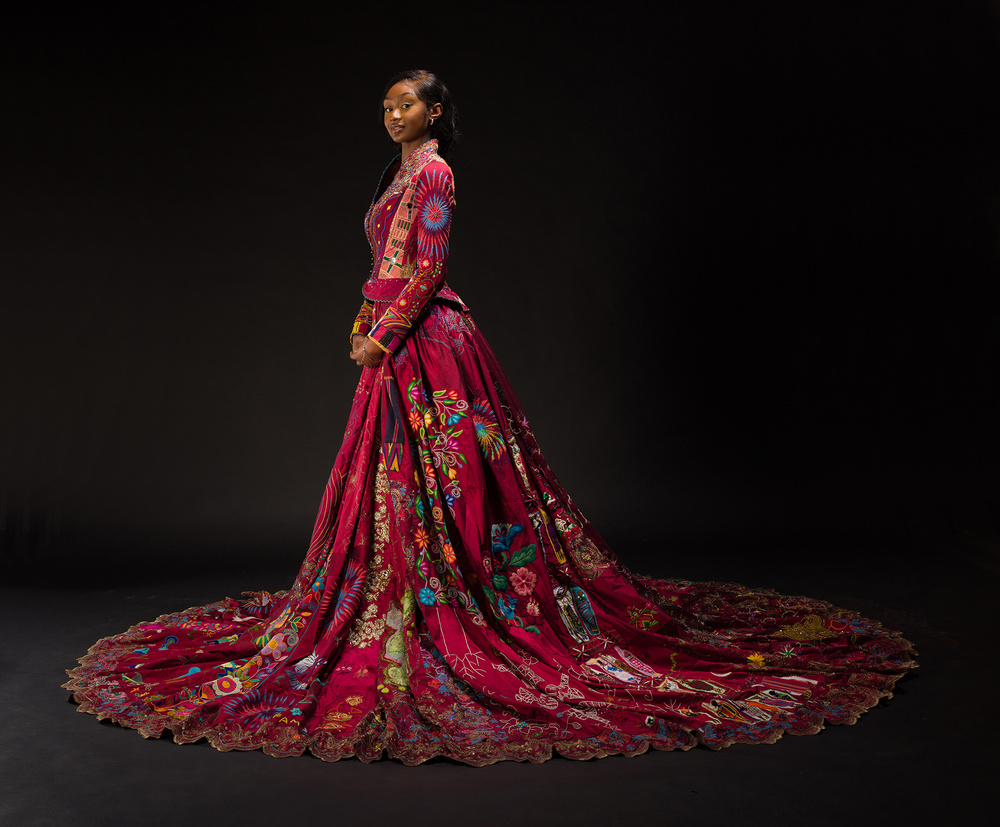
The Red Dress was made by 380 embroiders using more than 1 billion stitches. (Supplied: The Red Dress Australia/Image: Mark Pickthall)
Creator of the Red Dress Project, British artist Kirstie Macleod, who came to Brisbane for the exhibit, says the intention of the project was to open a “dialogue on identity through embroidery”.
“It absolutely achieved that original intention, but it also evolved far beyond anything I could have imagined,” Kirstie says. “[It] became a platform for storytelling, cultural exchange and human connection.
“The dress has given many people – particularly women from vulnerable communities – a chance to share their voices, skills and experiences with audiences around the world.”
Back in 2009, Kirstie began distributing panels of burgundy silk dupion to embroiders she identified through charities, NGOs, friends, fellow artists, and word of mouth: from Palestine, Syria, and Ukraine, to South Africa, Rwanda, Democratic Republic of Congo and Australia.
Among them were refugees and businesswomen, war survivors and students, textile professionals and first timers.
Over the following 14 years, as the panels returned to Kirstie etched with stories of nature, nurture, resistance, struggle and hope, Kirstie along with wedding-dress maker Gail Falconer sewed them together and the dress took form.
It now holds the Guinness World Record for the largest collaborative embroidery in history.
In all, 380 embroiders from 51 countries added an estimated 1-1.5 billion stitches to the dress, which now weighs 6.8 kilograms. But the stitches carry more weight than can be measured with scales.
“As each embroidered panel returned, the colours, textures and stories began to influence the composition,” Kirstie says.
“It became a truly collaborative artwork, with every contributor helping to shape its final appearance.”
Australian embroiders add to ‘universal energy of connecting people’
One of those contributors was the Allthreads Embroidery community in Brisbane.
In 2018, 27 members of the Allthreads Embroidery community stitched a panel celebrating Australia’s flora, fauna, and unique landscape.
Kerryn Lightfoot, who owns the Allthreads Embroidery business, says she was “definitely on board” when she looked into the project.
“I thought that the vision that Kirstie had to bring embroiderers from all over the world together to create a project was fantastic,” Kerryn says.
“We were part of something very global.
“Most cultures have access to needle and thread, and in different forms, create their own embroidery.”
Kerryn thinks that for some of the embroiders, such as those suffering isolation or the ongoing impacts of trauma, the project has been cathartic.
“There’s something about sitting, whether it’s on your own or in a group stitching, that is very therapeutic,” she says.
“You can switch off from the world, you can switch off from your worries. So, I think the dress has been a healing process for some of the embroiderers.”
Allthreads, together with the Queensland Women’s Historical Association, has led the campaign to bring the dress to Australia.
Through fundraising, including a Celebrating Multicultural Queensland (CMQ) grant from the Queensland Government, they’ve managed to bring the dress and artist over, as well as covering fees like insurance and transport. But they’ll also be calling on the support of an army of volunteers.
Queensland Women’s Historical Association Vice President Janelle Byrne says the dress is deeply aligned with the work of the Association.
“We believe that the history that we’re preserving reflects the diversity and contribution of women in all spheres-- paid and unpaid labour,” Janelle says.
“The intention of the dress was… to elevate women’s voices, to tell women’s stories, to create a collaborative textile without borders or boundaries.
“It seems like the dress almost has a life and energy of its own and the people drawn to it contribute to that universal energy of connecting people.”
Rwandan women’s story ‘changed me’
The stories captured on the dress range from scenes of beauty to deeply moving themes of hardship and resilience.
Kirstie says every contribution has its own significance, and that the light and shade coalesces to tell a bigger story about our shared humanity.
However, she says one panel called “From Darkness to Light”, embroidered by the Aprohade women from Rwanda, not only changed the way she steered the Red Dress project, but changed her as a person.
“It depicts the horrors and brutality of war at the centre of a tightly wound black spiral, which gradually unfolds into a vibrant, multicoloured sun,” Kirstie says.
“The journey from suffering to healing embodied within that panel is profound and deeply humbling. Holding it in my hands changed me.”
The Aprohade women and all other commissioned contributors were paid for their work and continue to receive annual donations through money raised via the project’s exhibitions and merchandise.
The Red Dress was on display at the Warwick Art Gallery between 16-22 July and is on display at the Museum of Brisbane between 25 July – 13 September.
Museum of Brisbane Assistant Curator Gabrielle Bergman says she hopes the exhibit serves as a testament to the power of art and storytelling.
“Here at the Museum of Brisbane, we are very proud to champion our local creative community,” Gabrielle says. “So, we’re really thrilled to be able to host the Red Dress while it comes to Australia for the first time.
“I hope that [audiences] can witness the power of art to bring together community and create connection and also to build a sense of hope and resilience and livelihood.”
The exhibition is free for the general public.
Project creator Kirstie says it feels “incredibly special” to see the dress in Australia, and hopes its legacy will continue to evolve.
“Australia has been part of the Red Dress story since 2018 through the wonderful embroiders of Allthreads,” she says. “The dress demonstrates what can happen when people work together with generosity, creativity and respect.
“Long after the exhibition tour ends, I hope it continues to inspire conversations about empathy, cultural exchange and the value of every person’s story.”