
Honouring culture, recognition and community
As Australia marks NAIDOC Week this year and celebrates 50 Years of Deadly, we recognise the strength, resilience and achievements of Aboriginal peoples and Torres Strait Islander peoples, and the generations of leaders, Elders and advocates whose vision continues to shape a stronger future.
One significant example is the Meriba Omasker Kaziw Kazipa (Torres Strait Islander Traditional Child Rearing Practice) Act 2020, and the work of the Commissioner and his team which provides legal recognition of the Torres Strait Islander traditional child-rearing practice.
The Act was the culmination of more than three decades of advocacy by Torres Strait Islander Elders, leaders and community members, whose determination ensured that a cultural practice observed for countless generations would finally receive formal legal recognition within Queensland’s legal system.
Reflecting on this year's NAIDOC Week theme, 50 Years of Deadly, Commissioner Meriba Omasker Kaziw Kazipa, C’Zarke Maza said the milestone was both a celebration of the past and a reminder that culture remains a living and enduring part of contemporary Australia.
“Fifty Years of Deadly is an opportunity to recognise the strength of those who came before us and whose determination ensured that our cultures continue to be respected, celebrated and recognised,” Commissioner Maza said.
“The Meriba Omasker Kaziw Kazipa Act exists because people like the late Uncle Steve Mam, Dr Ivy Trevallion, Dr McRose Elu, Uncle Francis Tapim, Uncle Belzah Lowah, the late Uncle Dana Ober, Hon. Alistair Nicholson and Paul Ban believed our cultural laws deserved recognition alongside Australian law. Their persistence over more than 30 years has created lasting change for generations of Torres Strait Islander families.
“Every Cultural Recognition Order granted today carries their legacy forward. It demonstrates that Indigenous customary law and Australian law can coexist with dignity, each strengthening the other without diminishing either”.
Now entering its fifth year of operation, the Act continues to deliver meaningful outcomes for Torres Strait Islander families and communities.
Since it commenced, more than 880 individuals—including children, cultural parents, birth parents, and extended family members—have benefited through the granting of 147 Cultural Recognition Orders.
While these milestones are significant, Commissioner Maza said the true impact is measured through the lives of the families supported.
“The impact has been profound and deeply personal,” he said.
“We supported a young child with complex medical needs whose cultural parents couldn’t access essential healthcare because they were not legally recognised as parents. Following the granting of a Cultural Recognition Order, those barriers were removed.
“We also assisted an 88-year-old Elder to receive their first-ever birth certificate almost nine decades after being born on a remote island in the Torres Strait. Holding that certificate for the first time was described as empowering.’
“These stories remind us that this legislation is about much more than legal processes. It aligns legal identity with lived and cultural identity, strengthening access to healthcare, education, banking, aged care and many of the everyday services many Australians simply take for granted.”
Community focussed
“Our focus is on ensuring every Torres Strait Islander family understands that this process is confidential, culturally safe and designed by community, for community.”
—Commissioner Meriba Omasker Kaziw Kazipa, C’Zarke Maza
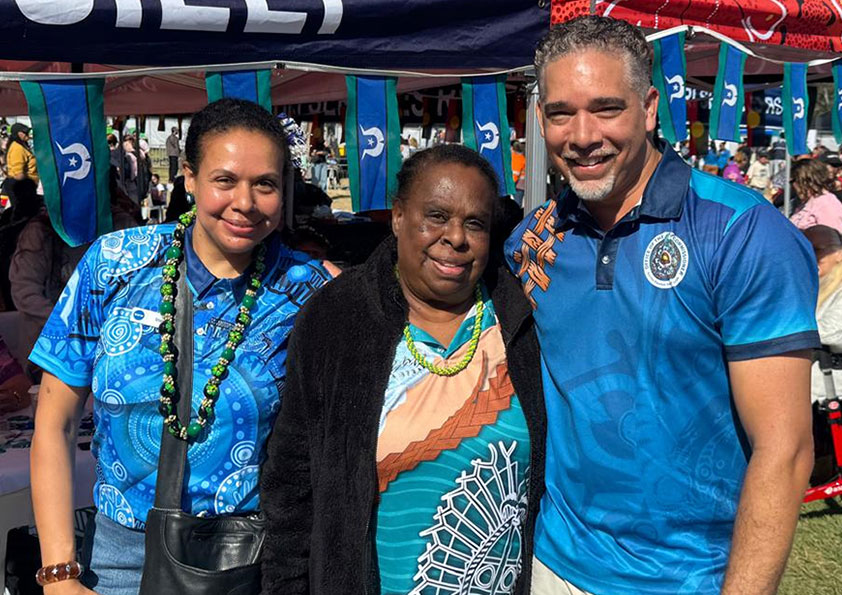
Image supplied
Community engagement remains central to the successful operation of the Act. Through ongoing outreach across the Torres Strait and mainland Queensland, Cultural Support Officers work directly with families, ensuring culturally informed guidance and support is available throughout the application process.
Commissioner Maza said building awareness and accessibility continues to be one of the Office’s highest priorities.
“Recognition only has meaning if families know it exists and can access it with confidence,” he said.
“Our focus is on ensuring every Torres Strait Islander family understands that this process is confidential, culturally safe and designed by community, for community. Whether through community visits, strengthening partnerships, improving access across Queensland, or simply starting conversations through the use of our merchandise at community events, every interaction helps raise awareness of the Act and the support available to families.
“Awareness is built one conversation at a time, and every conversation creates another opportunity for families to learn about their rights, their culture and the legal recognition now available through the Act.”
Looking to the future, Commissioner Maza said he hoped the legislation would continue to support the preservation of Torres Strait Islander culture while also informing broader conversations about Indigenous customary law across Australia.
“My hope is that Ailan Kastom child-rearing continues exactly as it always has—as a living, breathing practice within our families, but now with the law standing behind it instead of against it,” he said.
“More broadly, I hope this Act becomes a blueprint for how Australia thinks about Indigenous customary law generally.
“We have shown that two legal systems can coexist with dignity and without one diminishing the other. My hope is that Indigenous knowledge and authority continue to help shape the laws and systems that affect Indigenous lives.”
Asking Commissioner Maza about a book or piece of writing from an Aboriginal or Torres Strait Islander author that inspired him, C'Zarke acknowledged the book, Piri Piri Mab, compiled by Paul Ban and members of the Kupai Omasker Working Party, including Dr Ivy Trevallion, Dr McRose Elu, the late Dana Ober, Uncle Francis Tapim and Uncle Belzah Lowah.
“Reading the working party members’ first-hand accounts gave me a much deeper appreciation of the strength and persistence behind a legal change that I now work with every day,” he said.
“It is a reminder that the processes we work within exist because a small group of Torres Strait Islander people refused to give up, and that their legacy deserves to be honoured through the care and diligence we bring to this work.”
As we celebrate 50 Years of Deadly, we honour those whose advocacy made this historic reform possible, recognise the families and communities who continue to shape its success, and reaffirm our commitment to supporting outcomes that strengthen culture, identity and self-determination for future generations.
Because deadly isn't just what has been achieved—it is the strength we inherit, the legacy we honour and the future we continue to build together.
 This work is licensed under a Creative Commons Attribution 4.0 International (CC BY 4.0) licence