
'Ask for help'. PM’s science prize winner Lidia Morawska shares a simple message for new migrants
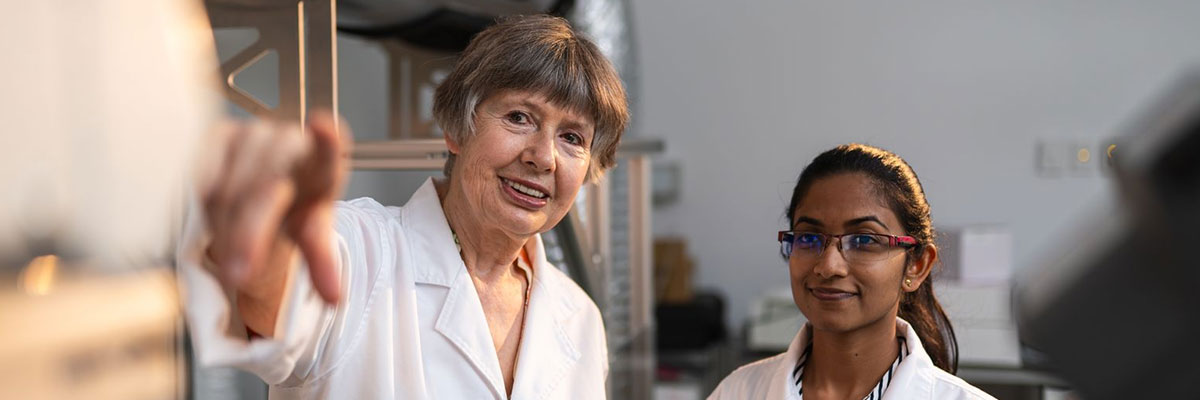
Earlier this month, Queensland aerosol physicist Professor Lidia Morawska received Australia’s highest scientific honour, the Prime Minister’s Prize for Science.
It’s the latest milestone in a career spent helping the world understand air quality and its impacts on human health.
But like more than 1 in 5 Queenslanders, her journey began overseas. And despite the global recognition she holds today, her early days in Australia were marked by huge personal hardship.
Her advice to new migrants is simple: "Ask for help".
Life-changing news
Born and raised in Poland, Professor Morawska had her heart set on nuclear physics from a young age. After completing a degree and PhD in Krakow, she accepted a prestigious fellowship in Canada.
But as she was preparing to farewell Poland for her Canadian adventure, she received life-changing news.
"I had a family—two daughters—and two weeks before leaving for Canada, my husband was diagnosed with melanoma," Professor Morawska says.
"Medical doctors assured me [his prognosis] would be better in Canada."
So they went ahead with the move.
Three years later, and having shifted her study focus, this time to ultrafine airborne particles and their impacts on human health, Professor Morawska was offered a senior lecturer position at the Queensland University of Technology (QUT).
With her husband’s cancer seemingly in remission, the family packed up their lives again, this time bound for Brisbane.
Coming to Australia
Even before landing in Australia, she sensed she would fit in. Already fluent in English, Professor Morawska says she felt at home instantly. "I remember having that feeling already on the plane," she says. "Australia was very welcoming".
Within a year, Professor Morawska had established QUT’s Environmental Aerosol Laboratory. But life took another devasting turn. "A year after we came to Brisbane, [the cancer] had come back and [my husband] passed away," she says. "I had two young children, aged 5 and 9, and I had to build a life for us in a country I had never visited, as well as take on a new professional role. It was the most difficult time in my life."
But despite the incredible hardship, and with the help of her community, she persevered. "The support I received from everyone, from my university colleagues to our neighbours, was incredible. It made me feel like I had come home."
A global voice on air quality
Her expertise has shaped worldwide responses to airborne health threats. When SARS CoV-1 spread through a Hong Kong apartment tower in 2003, the World Health Organisation called on her to help understand what had happened.
In late 2019 and into 2020, she again played a central role—first advising on the health impacts of bushfire smoke, then helping the world grasp how COVID-19 moved through the air.
Her work informed global guidance, saved lives, and earned her a place on Time magazine’s list of the 100 most influential people of 2021.
Today, she’s focused on improving indoor air quality standards, an issue she believes will only grow as climate change increases extreme weather and bushfire events. She still leads her QUT laboratory, now known as the International Laboratory for Air Quality and Health.
‘Just ask for help’
Life looks different now. She has remarried, and her husband volunteers with newly arrived migrants who speak little English.
She’s the first to admit she had advantages that many migrants don’t, including a university education and strong English. But she believes the broader message still holds.
Support and opportunities are available to new migrants, and she hopes people are empowered to reach out when they need assistance.
"You shouldn’t assume that because you are different, or because you have come from somewhere else, that you won’t be treated well," she says.
"There's a lot of support in the community. But you need to ask for it".
Her advice is as simple as it is powerful, "just ask for help."
Image credit: Department of Industry, Science and Resources
 This work is licensed under a Creative Commons Attribution 4.0 International (CC BY 4.0) licence